Gaming: Amd's Unannounced Dual-ccd 3d V-cache Monster Chip Appears In...
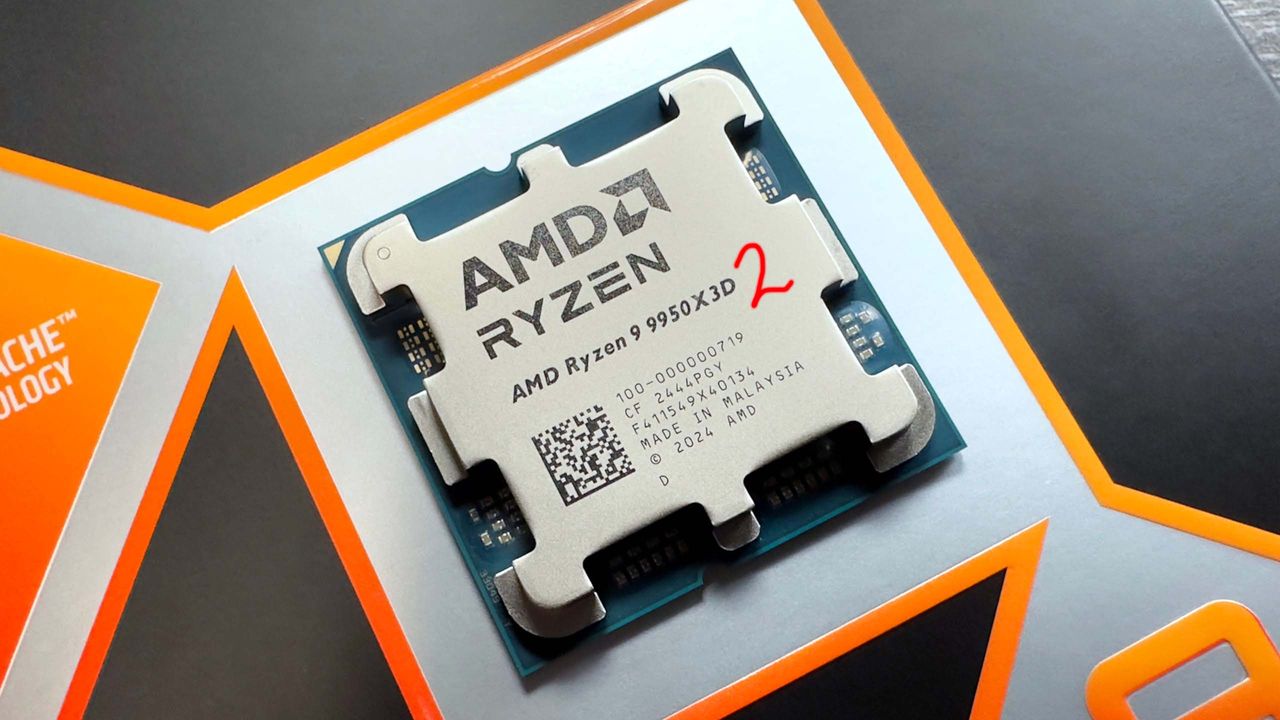
The new AMD Ryzen 9 9950X3D2 has shown up in an EEC listing from Friday.
Despite the fact that AMD's next-gen desktop CPU architecture, Zen 6, isn't expected to appear until towards the end of this year, we were expecting at least two new desktop chips to arrive at CES this month. But no, all we got was a single Ryzen 7 9850X3D announcement and no mention whatsoever of the vaunted dual-CCD 3D V-Cache chip.
But a new EEC listing from AMD before the weekend has listed a new Ryzen 9 9950X3D2 processor alongside the Ryzen 7 9850X3D and a bunch of Threadripper chips.
To bring you up to speed, 3D V-Cache is AMD's bespoke technology which underlays an extra chunk of L3 cache underneath the processor cores in a Zen 5 CPU package. The benefit of this is that games in particular benefit from all that extra on-die memory, reducing the number of times programs have to dip into slower system memory and therefore boosting frame rates.
On chips, such as the Ryzen 9 9800X3D, and the upcoming 9850X3D, that means all eight of the CPU cores get access to a whole lot more cache. But for the Ryzen 9 9950X3D and 9900X3D chips, which have multiple core complex dies (CCD) to accommodate their higher core counts, only one CCD gets the extra cache. With the proposed Ryzen9 9950X3D2, however, the expectation is that both CCDs come with a layer of L3 cache under their cores for a combined total of 192 MB.
This isn't the first official notice we've had for the chip, with Alienware China presumably a little premature with its announcement of an Area-51 desktop sporting the new chip, and SI Systronic also listing a new workstation machine with it, too. But aside from a casual "stay tuned" to a few journalists at CES when they asked after its whereabouts, this is the first official AMD posting about the beefy, though potentially unnecessary CPU.
I mean, AMD itself, in a conversation with HardwareLuxx last year has said that while there were no technical limitations preventing it from creating a 3D V-Cache chip with both core complex dies (CCD) given an extra dollop of L3 cache, such a chip would be too expensive, "and games wouldn't benefit from a second CCD with 3D V-Cache to the same extent as the increase from 32 MB to 96 MB of L3 cache for a single CCD."
Basically, there's no real point, at least not for a desktop gaming chip. But if there is an appetite out there, and it has been proven that gamers will pay through the nose just to have something even just theoretically 'the
Source: PC Gamer