Commodore 64 Floppy Drive Has The Power To Be A Computer And Runs
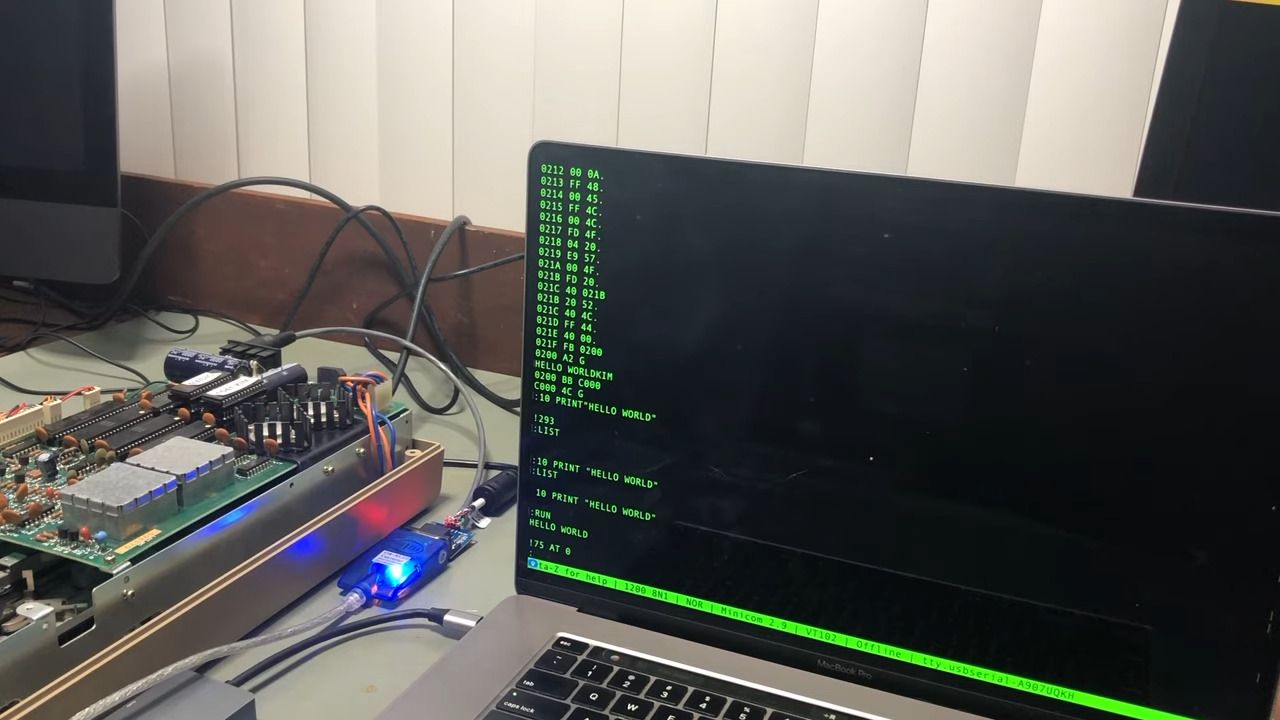
The Commodore History channel on YouTube has confirmed that the Commodore 1541 floppy disk drives electronics are powerful and capable enough to work as a standalone computer. This 1982 vintage peripheral, designed to add a 5.25-inch floppy disc to the equally ancient Commodore 64, actually has its own processor, RAM, ROM and I/O.
There’s a 1 MHz MOS 6502 in the floppy drive electronics, which is closely related to the C64’s MOS 6510, and exactly the same processor as in the VIC-20. However, Dave from the Commodore History channel did his work with minimal hardware modding, so the resulting ‘1541 computer’ ended up being rather limited.
Turning the 1541 into a VIC-20-a-like was still too much of a stretch for this investigation, as Dave wanted to keep hardware modding off the menu. The VIC-20 owes a lot of its general purpose computing ability to its additional 6560 VIC chip – a custom IC for graphics and sound. It also offers lot more I/O for general purpose computing appeal.
Thus, Dave had to wind-back the Commodore clock even further for inspiration. And he decided the first way to demonstrate that the Commodore 1541 floppy disk could work as a general purpose computer was to look at the Commodore KIM-1, the firm’s first, and most simple computer, which would be described as a Single Board Computer (SBC) today.
The KIM-1 was programmed using an onboard keypad, punching in values in 6502 machine language, byte-by-byte. Its only display was a set of 6 segmented LCDs. This computer could also be used via Teletype (TTY) over serial connection, and this method was adopted as the way to interface and work with the Commodore 1541.
So, the KIM-1 became the new target of the Commodore 1541 as a computer project. Dave found the KIM-1 kernel had already been published, so set about modifying it with code to initialize the 1541, and tweak I/O routines so serial teletype would work. This code was burned onto an EEPROM, and is now available on GitHub.
Get Tom's Hardware's best news and in-depth reviews, straight to your inbox.
To teletype interface with the pair of 1541 serial connectors, an adaptor / dongle was required. Dave brewed up a USB to RS232 to TTL dongle. The finished MacBook USB to 1541 serial adaptor looks a bit messy, but did the job.
Next up, Dave communicated with the 1541, with its freshly baked KIM-1 ROMs, and dongle, via a Minicom terminal on his Mac. His hand typed assembly Hello World code worked first time (as far as we saw in the video)
Source: HackerNews
