Gaming: Fast, Feisty, Fabulous: I've Benchmarked Intel's New Panther Lake...
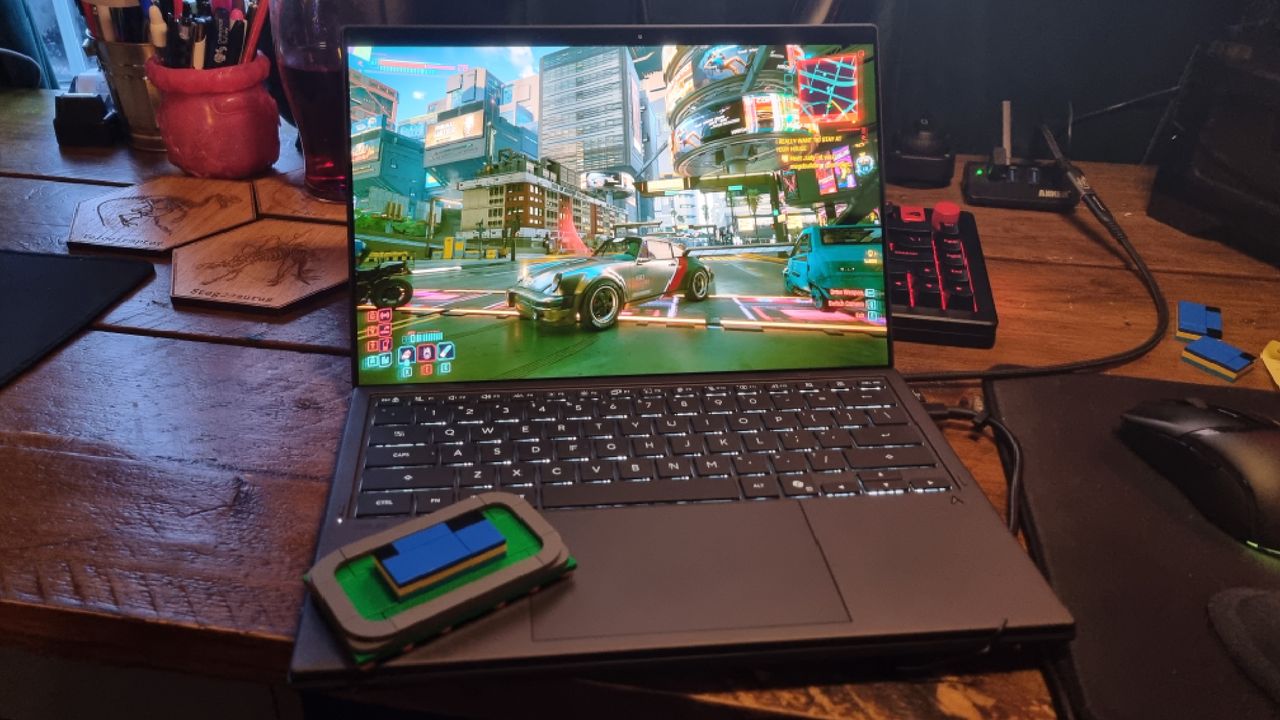
The artist formerly known as Panther Lake shows its teeth.
Panther Lake has finally arrived on my test bench. Well, the chip "formerly codenamed" Panther Lake, anyway. Intel would much prefer we refer to its new chip generation as the Intel Core Ultra Series 3—which is the name you'll find emblazoned on the specs sheet of many thin and light laptops in the next few months. And maybe the odd handheld eventually, too.
The headline news here is the gaming performance, as Intel has supercharged the onboard iGPU of several of its new chips to provide a sizable whack of graphics grunt. I've been testing an Asus Zenbook Duo equipped with the very tippety-top of the lineup, the Intel Core Ultra X9 388H, complete with a 12 Xe3 core-equipped Intel Arc B390 iGPU. One thing has become immediately obvious—it's a surprisingly grunty graphics cruncher when pushed to its limits.
Now, some expectation-tempering before we start. As an iGPU, the Arc B390 onboard the Core Ultra X9 388H amounts to a single, somewhat-sizable graphics tile, with 12 Xe3 cores, 12 Ray Tracing Units, 96 Xe Vector Engines and XMX engines respectively, and 16 MB of L2 cache. That's an impressive specs sheet for an integrated GPU, but compared to your average discrete unit, it's very, very small scale.
So, no-one's expecting the Arc B390 to do battle with, say, the RTX 5060 mobile found in many modern budget gaming laptops. Intel, though, is claiming it's around 10% faster than a 60 W TGP-limited RTX 4050 mobile on average, and that's a very modest slice of graphics hardware to beat in 2026.
What we should be excited about, however, is what those claims mean for sleek and slim, productivity-style, dGPU-less laptops that could almost now be classed as gaming laptops. Compress some genuine gaming performance into a single mobile chip, and you could potentially end up with a wealth of svelte, light-as-a-feather mobile machines that can handle a bit of Cyberpunk 2077 on the side.
Not to mention handhelds, the first of which I am assured will be revealed "soon". We can but dream. Anyway, on with the testing.
For the purpose of direct comparison with our other iGPUs, the Lunar Lake-generation Intel Arc 140V and the Strix Point-based AMD Radeon 890M, I've recorded all my real-world gaming results at 1080p, with varying settings indicated in the charts below.
Kicking things off with Cyberpunk 2077, I already had a good idea what to expect. I got a chance to perform some quick and dirty benchmarking of
Source: PC Gamer