Free Universe's Expansion 'is Now Slowing, Not Speeding Up' 2025
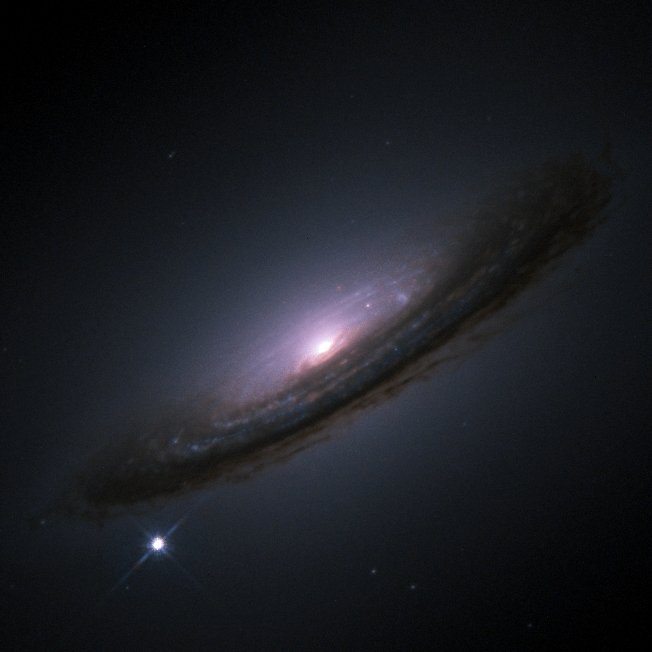
The universe's expansion may actually have started to slow rather than accelerating at an ever-increasing rate as previously thought, a new study suggests.
"Remarkable" findings published today in Monthly Notices of the Royal Astronomical Society cast doubt on the long-standing theory that a mysterious force known as 'dark energy' is driving distant galaxies away increasingly faster.
Instead, they show no evidence of an accelerating universe.
If the results are confirmed it could open an entirely new chapter in scientists' quest to uncover the true nature of dark energy, resolve the 'Hubble tension', and understand the past and future of the universe.
Lead researcher Professor Young-Wook Lee, of Yonsei University in South Korea, said: "Our study shows that the universe has already entered a phase of decelerated expansion at the present epoch and that dark energy evolves with time much more rapidly than previously thought.
"If these results are confirmed, it would mark a major paradigm shift in cosmology since the discovery of dark energy 27 years ago."
For the past three decades, astronomers have widely believed that the universe is expanding at an ever-increasing rate, driven by an unseen phenomenon called dark energy that acts as a kind of anti-gravity.
This conclusion, based on distance measurements to faraway galaxies using type Ia supernovae, earned the 2011 Nobel Prize in Physics.
However, a team of astronomers at Yonsei University have now put forward new evidence that type Ia supernovae, long regarded as the universe’s "standard candles", are in fact strongly affected by the age of their progenitor stars.
Even after luminosity standardisation, supernovae from younger stellar populations appear systematically fainter, while those from older populations appear brighter.
Source: HackerNews
