Goodbye Text Fringing: Lg's New Rgb Stripe Panel Might Solve One Of...
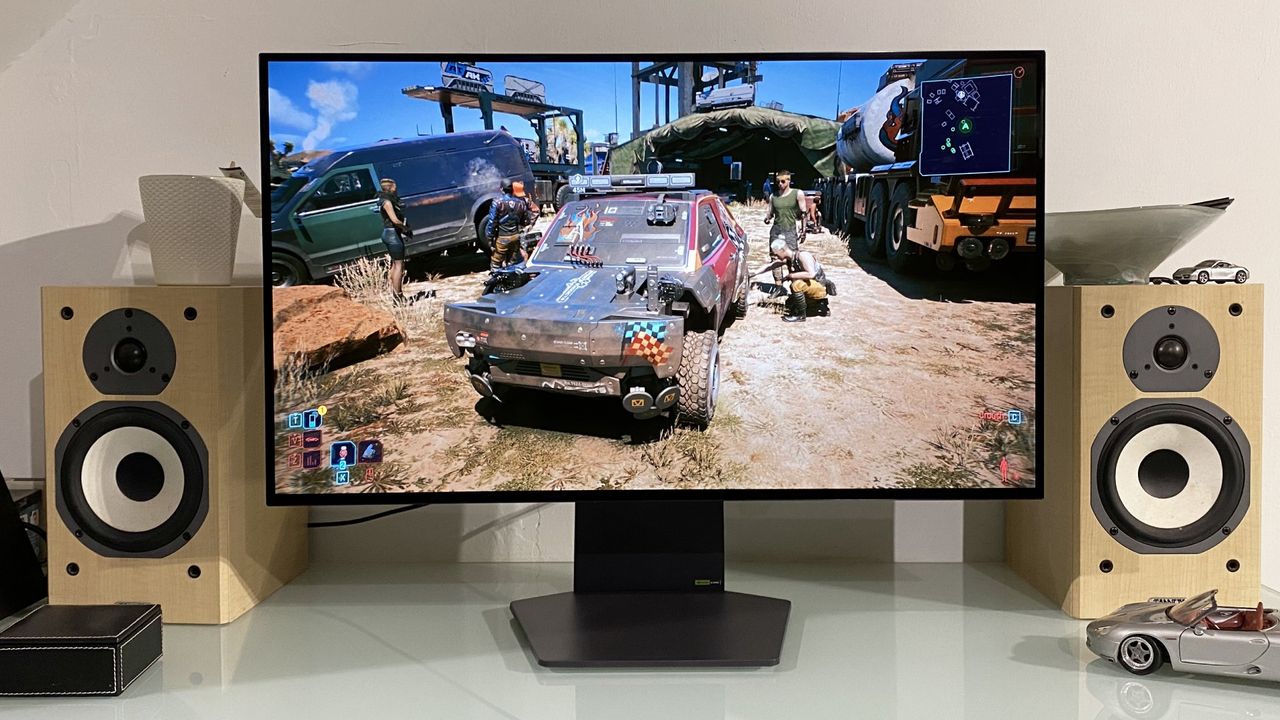
Here's some great news out of LG. The company has unveiled a new OLED panel that runs at a high refresh rate and uses an RGB Stripe subpixel layout. If you're not familiar with subpixel layouts, here's why that's a very good thing.
Today's OLED gaming monitors have an issue. Not a huge one for gaming—any OLED is superb for playing games on—but more noticeable on some panels than others when you're browsing your desktop. It's especially noticeable if you're regularly typing out pages of words. It's called text fringing.
Text fringing, as the name suggests, appears as a colourful border around characters rendered on an OLED panel. Sort of like a chromatic aberration effect in-game. It happens because the subpixels—red, green, and blue—don't align exactly with how the text is being rendered. In some OLED panels, that's because the subpixels are arranged in a triangular pattern, though LG's popular panels include a white subpixel in an RGWB structure.
Text fringing is most obvious on panels with lower pixel densities, so namely 1440p monitors, though it'd be better to be rid of it completely.
Well, that's what LG is offering with its latest OLED panel. Announced ahead of CES 2026, LG's new 4K, 27-inch OLED panel is using an RGB Stripe subpixel layout. The subpixels are aligned as stripes of red, green, and blue—more the norm.
"Existing high-end Gaming OLED monitor panels have primarily used RGWB structures," LG says, "which include a white subpixel, or configurations where RGB pixels are arranged in a triangular pattern.
"As LG Display developed its new pattern optimized for monitor use, it applied various new technologies—such as increasing the aperture ratio, which is the proportion of the pixel area that emits light. As a result, it achieved the world first of implementing both an RGB stripe structure and a high refresh rate simultaneously."
Keep up to date with the most important stories and the best deals, as picked by the PC Gamer team.
The new OLED panel can run up to 240 Hz at 4K, or 480 Hz at 1080p.
"This product’s high refresh rate not only delivers optimal performance in first-person shooter (FPS) games and other applications that require rapid screen transitions, but it is also optimized for operating systems such as Windows and for font-rendering engines, ensuring excellent text readability and high color accuracy."
Source: PC Gamer