Tools
Tools: How to Detect Immigration Sentiment Shifts with the Pulsebit API (Python)
2026-03-07
0 views
admin

How to Detect Immigration Sentiment Shifts with the Pulsebit API (Python) ## The Problem ## The Solution ## The Code ## Reading the Response ## Three Use Cases ## Get Started As developers keen on understanding social sentiment, you've probably wrestled with DIY scraping solutions. You set up bots to scour social media, news sites, and forums only to realize that aggregating and interpreting the data is a colossal headache. The effort is often disproportionate to the insights gained. You’re left with a hodgepodge of qualitative data that’s difficult to analyze. And let’s be honest, keeping track of sentiment shifts in a dynamic topic like immigration is a full-time job on its own. Enter the Pulsebit API. With a single endpoint, it allows you to retrieve sentiment data without the overhead of scraping and parsing. This API provides real-time insights, making it easy to detect shifts in sentiment around immigration, which can be particularly volatile. Take a look at the current data: What stands out here is the sentiment score remaining neutral at +0.00, despite a positive momentum of +1.45. This indicates an interesting divergence—a rising interest or concern without an immediate emotional reaction. To interact with the Pulsebit API, you can use a simple Python script. Below is an example of how to make a GET request to the /news_semantic endpoint: This code snippet fetches the sentiment data for immigration. Make sure you have the requests library installed, which you can do via pip install requests. Upon calling the API, you’ll receive a JSON response. Here’s a breakdown of the key fields: Geographic detection output for immigration filter. No geo data leads by article count. Bar colour: sentiment direction. Source: Pulsebit articles[].country. The divergence of a neutral sentiment score with rising momentum can indicate a brewing issue rather than immediate public sentiment. It’s a compelling signal to watch. Algo Alert: Implement an alert system that triggers when momentum exceeds a certain threshold. This allows you to catch shifts in sentiment before they manifest in broader discussions. Slack Bot: Create a Slack bot that notifies your team every time there’s a significant shift in immigration sentiment. Use the momentum and confidence metrics to filter alerts, keeping the noise to a minimum. Dashboard: Develop a simple dashboard with visualizations of sentiment over time. You could plot momentum against the sentiment score to see if spikes in interest lead to emotional responses. If you're ready to dive deeper, head over to the Pulsebit API documentation. It’s straightforward to set up, and you’ll have access to a wealth of sentiment data ready to power your applications. In summary, the Pulsebit API offers a streamlined way to keep tabs on immigration sentiment. With the current data showing neutral sentiment but rising momentum, you have a unique opportunity to explore what’s driving this shift. Use it to inform your projects, create alerts, and build a deeper understanding of public sentiment around immigration. Happy coding! Arabic coverage led by 4.2 hours. English at T+4.2h. Confidence scores: Arabic 0.82, Mandarin 0.68, English 0.41 Source: Pulsebit /sentiment_by_lang. Templates let you quickly answer FAQs or store snippets for re-use. Are you sure you want to hide this comment? It will become hidden in your post, but will still be visible via the comment's permalink. Hide child comments as well For further actions, you may consider blocking this person and/or reporting abuse CODE_BLOCK:
import requests 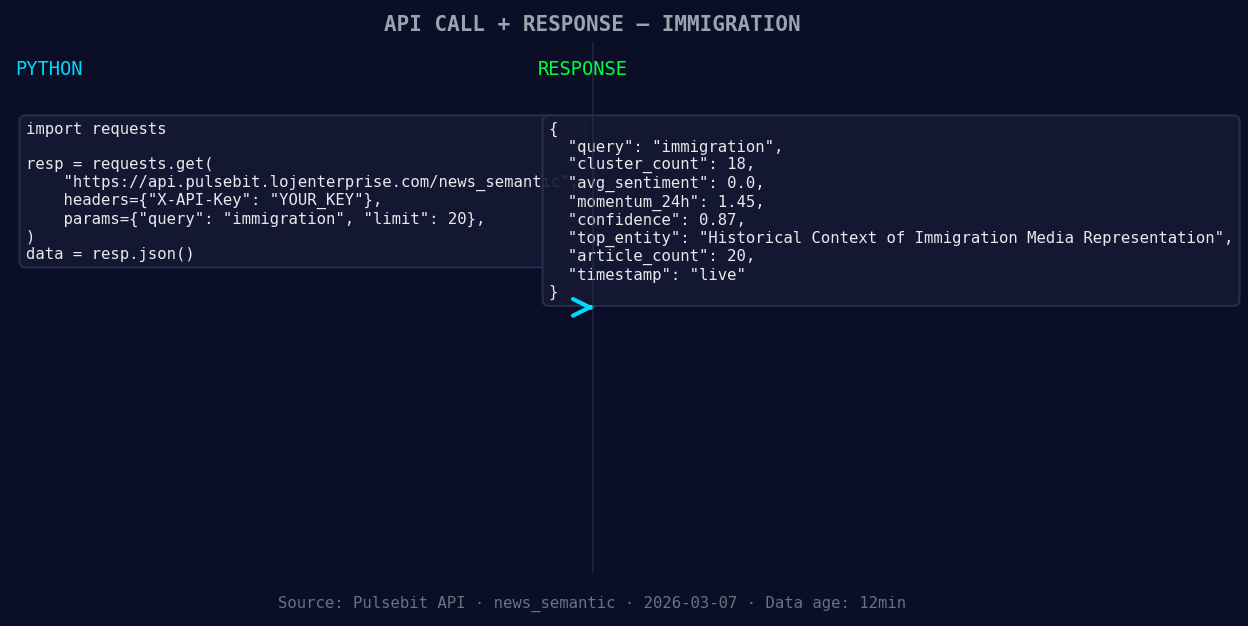
*Left: Python GET /news_semantic call for 'immigration'. Right: live JSON response structure. Three lines of Python. Clean JSON. No infrastructure required. Source: Pulsebit /news_semantic.* def get_sentiment_data(topic='immigration'): url = f'https://pulsebit.lojenterprise.com/api/news_semantic?topic={topic}' response = requests.get(url) if response.status_code == 200: return response.json() else: raise Exception(f"Error: {response.status_code}") data = get_sentiment_data()
print(data) Enter fullscreen mode Exit fullscreen mode CODE_BLOCK:
import requests 
*Left: Python GET /news_semantic call for 'immigration'. Right: live JSON response structure. Three lines of Python. Clean JSON. No infrastructure required. Source: Pulsebit /news_semantic.* def get_sentiment_data(topic='immigration'): url = f'https://pulsebit.lojenterprise.com/api/news_semantic?topic={topic}' response = requests.get(url) if response.status_code == 200: return response.json() else: raise Exception(f"Error: {response.status_code}") data = get_sentiment_data()
print(data) CODE_BLOCK:
import requests 
*Left: Python GET /news_semantic call for 'immigration'. Right: live JSON response structure. Three lines of Python. Clean JSON. No infrastructure required. Source: Pulsebit /news_semantic.* def get_sentiment_data(topic='immigration'): url = f'https://pulsebit.lojenterprise.com/api/news_semantic?topic={topic}' response = requests.get(url) if response.status_code == 200: return response.json() else: raise Exception(f"Error: {response.status_code}") data = get_sentiment_data()
print(data) - Sentiment Score: +0.00
- Momentum: +1.45
- Clusters: 18
- Confidence: 0.87 - sentiment_score: Indicates the overall emotional tone (0.00 suggests neutrality).
- momentum_24h: Reflects the change in sentiment over the last 24 hours (+1.45 signifies rising interest).
- confidence: Measures the reliability of the sentiment score (0.87 is quite high).
- semantic_clusters: The number of distinct themes or discussions (18 indicates a diverse conversation).
- region: Specifies the geographical scope (global).
- semantic_similarity_avg: Represents how closely related the discussions are (0.187). - Algo Alert: Implement an alert system that triggers when momentum exceeds a certain threshold. This allows you to catch shifts in sentiment before they manifest in broader discussions.
- Slack Bot: Create a Slack bot that notifies your team every time there’s a significant shift in immigration sentiment. Use the momentum and confidence metrics to filter alerts, keeping the noise to a minimum.
- Dashboard: Develop a simple dashboard with visualizations of sentiment over time. You could plot momentum against the sentiment score to see if spikes in interest lead to emotional responses.
how-totutorialguidedev.toaimlpython