Morgan Stanley Files S-1s For Bitcoin And Solana Etfs In Latest
The investment banking giant’s filings for Bitcoin and Solana ETFs follow an uptick in investor demand for regulated crypto investment vehicles, driven by the new year’s “clean-slate” effect.
Update Jan. 6, 12:57 p.m. UTC: This article has been updated to include a paragraph on Morgan Stanley’s prior involvement with cryptocurrency funds.
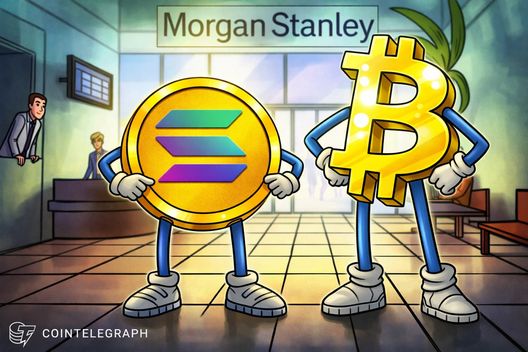
US investment bank Morgan Stanley has filed with the US Securities and Exchange Commission to launch two cryptocurrency exchange-traded funds (ETFs), one tied to Bitcoin and the other to Solana, as Wall Street firms push deeper into regulated digital-asset products.
The proposed Morgan Stanley Bitcoin (BTC) Trust and the Morgan Stanley Solana (SOL) Trust will function as “passive investment” vehicles that hold and track the performance of the underlying tokens, according to Tuesday’s filings with the SEC.
The two funds seek to list their shares on public exchanges, which are usually specified in later 19b-4 filings, not the initial S-1 forms.
If approved, the funds could bring new inflows to Bitcoin and Solana from Morgan Stanley’s over 19 million clients served through its wealth management division as of April 2025, according to the company’s shareholder letter.
Spot Bitcoin ETFs attracted $1.1 billion in inflows during the first two trading days of 2026, as analysts pointed to renewed digital asset appetite due to the new year’s “clean-slate effect.”
Related: Strategy kickstarts 2026 with $116M Bitcoin buy as Q4 paper loss hits $17B
Morgan Stanley Investment Management is listed as the sponsor for both proposed trusts. CSC Delaware Trust Company is named as the Delaware trustee. Key service providers, including certain custodial arrangements, were not fully specified in the preliminary documents. Morgan Stanley said it will keep a “substantial portion of the private keys” in cold storage with a “remainder” held in hot wallets.
The two funds won’t seek to generate returns beyond tracking the price of the underlying asset, meaning that the sponsor won’t “speculatively sell” the spot tokens.
Source: CoinTelegraph