Okay Asus, You've Intrigued Me: The Rog Zephyrus Duo Might Finally... (2026)
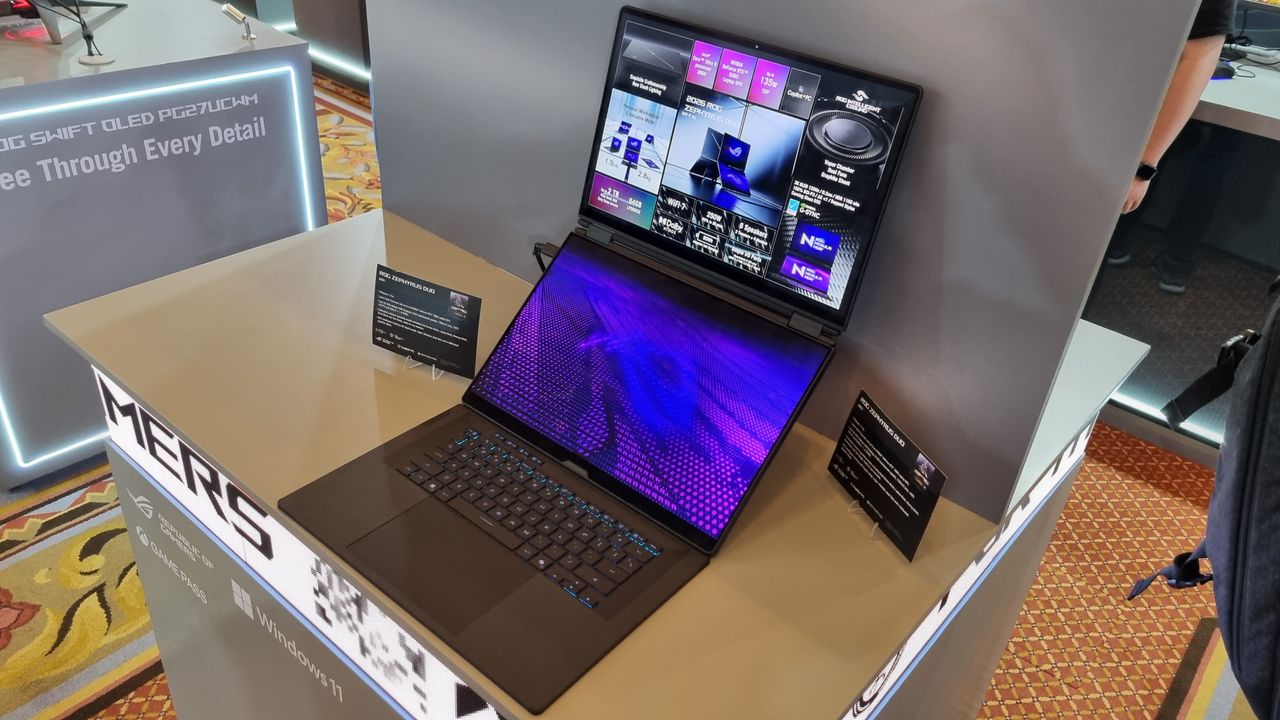
No, there's no need to adjust your set. Our Jacob already pointed out some of the virtues of the Asus ROG Zephyrus Duo earlier in the week. But he's sitting at home in the rain, whereas I'm in sunny Las Vegas, Nevada—and I've finally got my hands on one.
I'll be honest, I've never really got dual screen laptops. The ROG Zephyrus Duo 16 of yesteryear was undoubtedly a cool experiment, but eh, that slim second screen didn't exactly light my world on fire. This new one, though? I have to say, it's an awfully nice machine to experience in person.
As I type this piece, I'm sitting in my hotel room using a laptop with a 15-inch display. It's a decent size for gaming, but I'll be honest, juggling tabs around between dual browser windows is a massive pain in the arse.
Whereas the Asus ROG Zephyrus Duo (2026) looks like a delight to use for just such a purpose. You get two whole 16-inch 3K 120 Hz OLED screens to play with, hinged in the middle like a gigantic book, with the bottom screen holding most of the internals. It's also got a handy, robust-feeling metal kickstand on the bottom to keep the whole shebang in an upright position.
It'd fit nicely on a hotel room table I reckon. I could use the top screen for actual writing, and the bottom for reference materials, a YouTube video, or simply to annoy the hardware team when our paths cross on Slack.
The top configuration should be mighty powerful for gaming, too, as the Zephyrus Duo can be specced to the rafters with an RTX 5090 Mobile and the brand-spanking-new Intel Core Ultra 9 386H. Given the relatively slim bottom deck all that hardware is contained within, I'd imagine it's a bit of a hairdryer at full tilt—but hey, that's high-powered mobile gaming devices for you.
Rolling the Zephyrus Duo around in my hands, I couldn't help but be impressed by the fit and finish of the thing. The separate keyboard magnetically attaches on top of the bottom screen for traditional laptop usage, or can be used wirelessly when the two screen halves are in an upright position.
The magnetic force holding it on is plenty powerful (while also being easy to remove), and the hinge connecting the two screens feels built to last. It doesn't feel like a prototype, or a throwaway idea. You can tell there's been thought put into the design and material choices here, and that's pleasing to see.
It's a bit of a chonk, though. The weight's not awful by gaming laptop standards, coming in at 2.85 kg, but no-one's going to call it super-
Source: PC Gamer