Powerful Saving Japan's Exceptionally Rare 'snow Monsters'
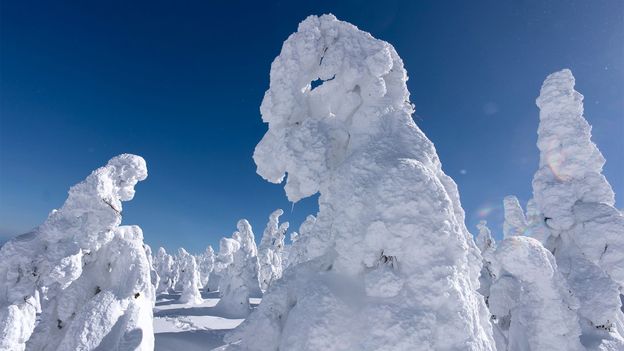
A unique natural wonder is being eroded. Can Japan bring its breathtaking "juhyo" back from the brink?
Each winter, the upper slopes of Mount Zao in northern Japan – one of the country's best-known ski areas – are transformed. Fir trees coated in thick frost and snow swell into ghostly figures known as "juhyo" or "snow monsters".
Juhyo form only under exceptionally rare atmospheric conditions, emerging when strong, persistent winter winds carry supercooled water droplets that freeze on contact with the local evergreen Aomori todomatsu trees, gradually layering into rime ice.
At Mount Zao, these formations occur during sustained westerly winds of up to 26m per second (85ft per second), with surface air temperatures between -6.3C to -0.1C (21-31F) and unusually high cloud liquid water content. Under these precise conditions, the rime thickens on the windward side of trees into overlapping ridges known as "shrimp tails", the distinctive shapes that cluster together to form the towering juhyo figures.
"Because such precise meteorological and ecological conditions align in very few places, Zao's snow monsters are a phenomenon almost unique to northern Japan," says Fumitaka Yanagisawa, an emeritus professor of geochemistry who studies the juhyo at Yamagata University.
The snow monsters are the biggest winter draw of the Zao area, a mountain range which lies between Japan's Yamagata and Miyagi prefectures and attracts tens of thousands of visitors annually.
But recent research indicates that the monsters are becoming slimmer.
In August 2025, a research team led by Yanagisawa announced findings that quantified what locals have long observed. By analysing identical-angle photographs of Zao's summit taken since 1933, the team measured the thickness of the figures on a six-point scale. The findings (which have not yet been published in a scientific journal) indicate a widespread shrinking of the juhyo.
"In the 1930s, we saw juhyo five to six metres [16-20ft] across," Yanagisawa says. "By the postwar decades, they were often two to three metres [7-10ft]. Since 2019, many are half a metre [1.6ft] or less. Some are barely columns."
The cause is twofold, says Yanagisawa: a warming climate and a forest under attack. The host tree, Aomori todomatsu, suffered a moth outbreak in 2013 that stripped its needles. Bark beetles followed in 2015, boring into weakened trunks. Yamagata officials report that around 23,000 firs, about a fifth of the prefectural side's stands,
Source: HackerNews
