Gaming: Rampocalypse Be Damned, I've Tested A Range Of Games To See If Slow...
PC gaming has always been an expensive hobby, even if you stick to entry-level hardware. So much so that the majority of enthusiasts only upgrade their systems piecemeal, one component every so often, or get a new rig after many long years. But if you were hoping to build a new gaming PC or update the CPU and motherboard this year, the shocking cost of DRAM kits right now is making the process considerably challenging.
Back in July 2025, you could pick up a 32 GB kit of DDR5-6000, with a CAS latency of 30 cycles, for under $90 (albeit during the sales). For AMD Ryzen processors, you honestly wouldn't need anything better, and although Intel's chips can handle faster DRAM, they'll still be just as happy with a kit like that.
Now, the same set of memory costs $480 at Amazon, and should you want RGB lighting or DRAM from Corsair or G.Skill, then you'll be handing over a lot more cash. You can pay less, of course, as this 32 GB kit from PUSkill is $300 at Amazon, for instance. No, I've never heard of that brand before, either, but one reason why it's so much cheaper is its speed and timings.
Rated to 4,800 MT/s and with a CAS latency of 38 cycles, this is a set that's only marginally faster than the first DDR5 kits that appeared around five years ago. Leaving the question about the manufacturer aside, let's consider the speed: Is DDR5-4800 too slow to use in a gaming PC? With 20% less bandwidth than DDR5-6000, and a CAS latency that's 56% higher (16.7 ns vs 10.7 ns), surely games are going to be affected? Well, let's find out.
PC Gamer test rig: AMD Ryzen 9 9900X | Asus ROG Strix LC III 360 AIO cooler | Nvidia GeForce RTX 5090 FE | 2 TB Samsung 990 Evo Plus SSD | Thermaltake ToughPower PF3 1050 W PSU | Thermal Grizzly Der8enchtable chassis | Acer XB280KH monitor | Windows 11 25H2
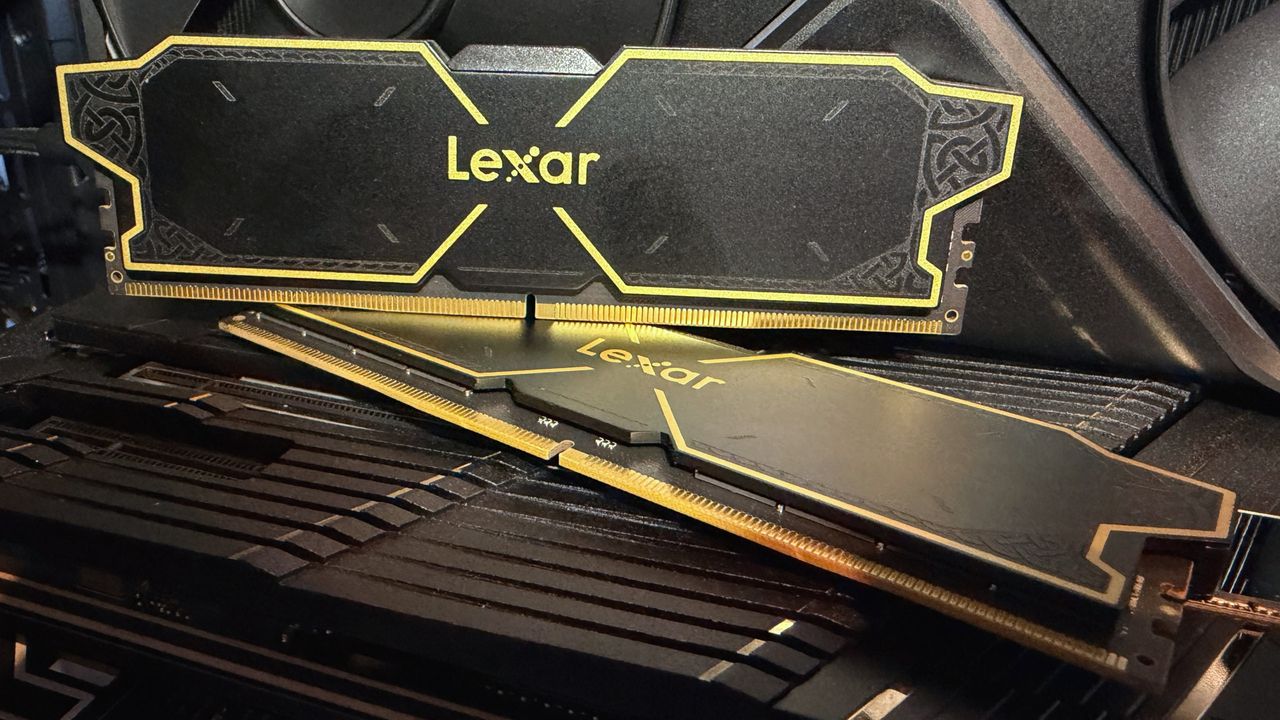
To test how much of an impact DRAM speed has on today's games (and to a lesser extent, timings as well), I've used a set of Lexar Thor OC DDR5-6000 CL32. Without enabling EXPO in the motherboard BIOS, it will run at 4800 MT/s, with a CAS latency of 40 cycles. While it's not quite a worst-case vs best-case scenario, as there is even slower DDR5 RAM out there, it's still relevant because that's the kind of 'cheap' memory around at the moment.
I've picked seven games in total: three that I didn't expect to see any difference in performance, and four that I suspected would run slower with the DRAM set to 4800 MT/s. I'll explain the reasons behind my forecasts as I break down the res
Source: PC Gamer