Series Of Tricks And Techniques I Learned Doing Tiny Glsl Demos
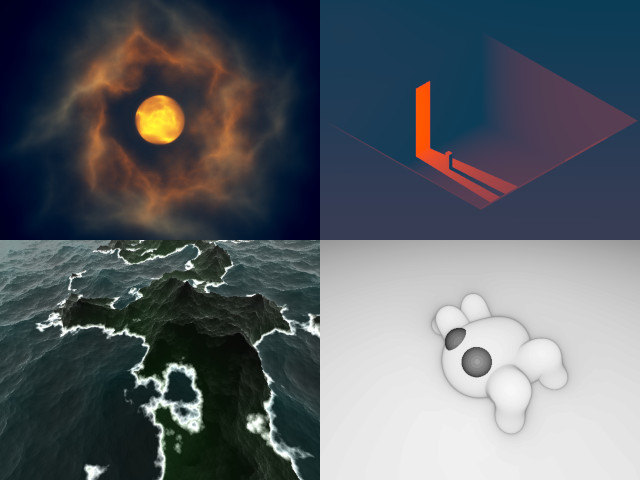
In the past two months or so, I spent some time making tiny GLSL demos. I wrote an article about the first one, Red Alp. There, I went into details about the whole process, so I recommend to check it out first if you're not familiar with the field.
We will look at 4 demos: Moonlight, Entrance 3, Archipelago, and Cutie. But this time, for each demo, we're going to cover one or two things I learned from it. It won't be a deep dive into every aspect because it would be extremely redundant. Instead, I'll take you along a journey of learning experiences.
See it on its official page, or play with the code on its Shadertoy portage.
In Red Alp, I used volumetric raymarching to go through the clouds and fog, and it took quite a significant part of the code to make the absorption and emission convincing. But there is an alternative technique that is surprisingly simpler.
In the raymarching loop, the color contribution at each iteration becomes 1/d or c/d where d is the density of the material at the current ray position, and c an optional color tint if you don't want to work in grayscale level. Some variants exist, for example 1/d^2, but we'll focus on 1/d.
Let's see how it looks in practice with a simple cube raymarch where we use this peculiar contribution:
The signed function of the cube is from the classic Inigo Quilez page. For the rotation you can refer to Xor or Blackle article. For the general understanding of the code, see my previous article on Red Alp.
The first time I saw it, I wondered whether it was a creative take, or if it was backed by physical properties.
Let's simplify the problem with the following figure:
The glowing object sends photons that spread all around it. The further we go from the object, the more spread these photons are, basically following the inverse square law 1/r^2, which gives the photons density, where r is the distance to the target object.
Source: HackerNews
