This New Mac Pro-inspired Motherboard Standard Banishes All Power...
DIY-APE takes his war on cables to a whole new level.
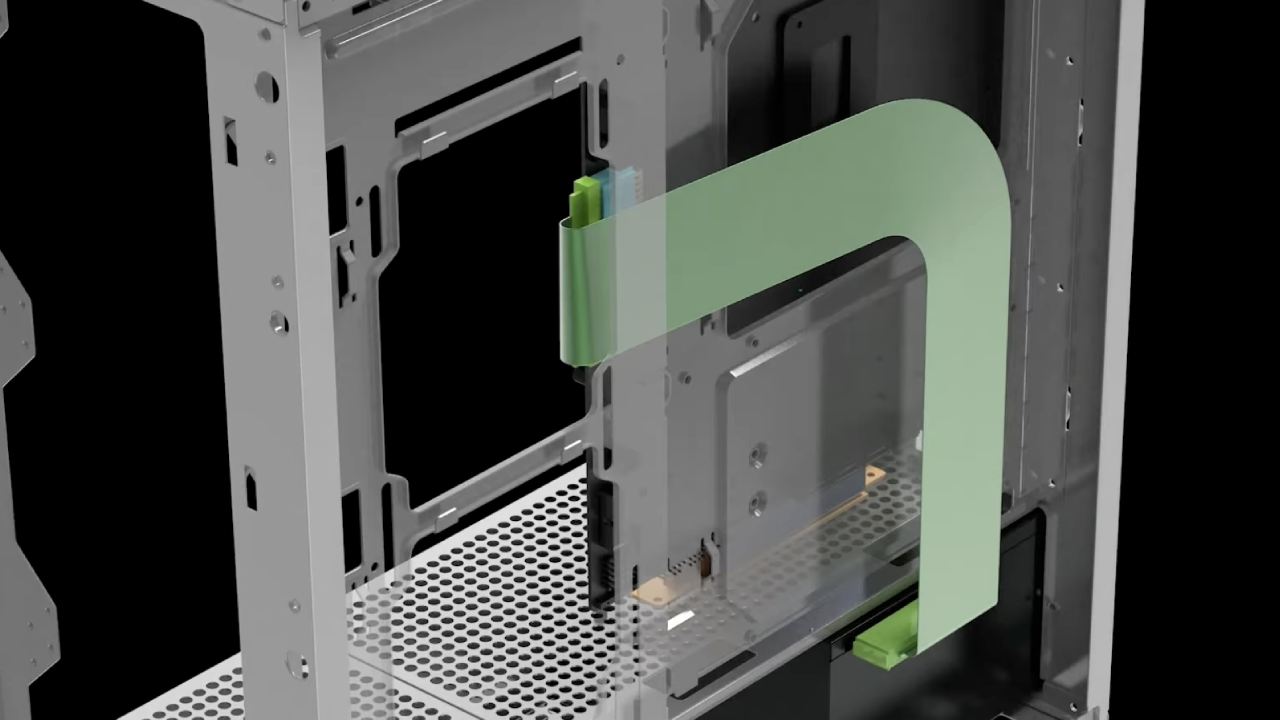
The latest version of the BTF or Back to the Future rear-connect standard for motherboards, BTF 3.0 , goes even further in its quest to banish cables for a super-clean look, this time consolidating power supply for everything into a single server-derived power slot rated at over 2,000 W.
BTF has always been about reducing cable clutter and moving what cables remain to the rear of the motherboard, allowing the topside to be as clean and clutter free as possible.
To that end, features like the BTF supplementary power connector for graphics cards does away with plug-in cables in favour of an additional slot on the motherboard—which in turn requires custom-designed graphics cards—are at the heart of the standard.
But for the most part, BTF 2.0 mostly moved cables and connectors to the rear of the motherboard rather than actually getting rid of them. The new BTF 3.0 revision, however, takes cable consolidation to a new level by amalgamating literally all power into a single 50-pin connector.
If that sounds ambitious, it's derived from the CRPS power supply standard used by enterprise servers, in which application it's rated to over 3,000 W. For BTF 3.0, this interface tops out at 2,145, with 1,680 W available for the CPU and GPU.
That's plenty for even the most demanding current processor and graphics card combo, which is probably a 270 W TDP AMD Ryzen 9 9950X3D paired with Nvidia's 650 W RTX 5090 graphics.
Another intriguing element is a new modular take on the aforementioned GPU power connector. The existing BTF standard means that compatible graphics cards can only be used on BTF motherboards.
Keep up to date with the most important stories and the best deals, as picked by the PC Gamer team.
With the new BTF 3.0 revision, a new GPU power board plugs directly into a standard 12V-2x6 12-pin GPU power socket on the end of the GPU board. In turn, that board then slots into the BTF GPU power socket on the motherboard, enabling a cable-free GPU.
Source: PC Gamer