Til The Wayback Machine Saves 150,000 Gigabytes Of Webpages Every...
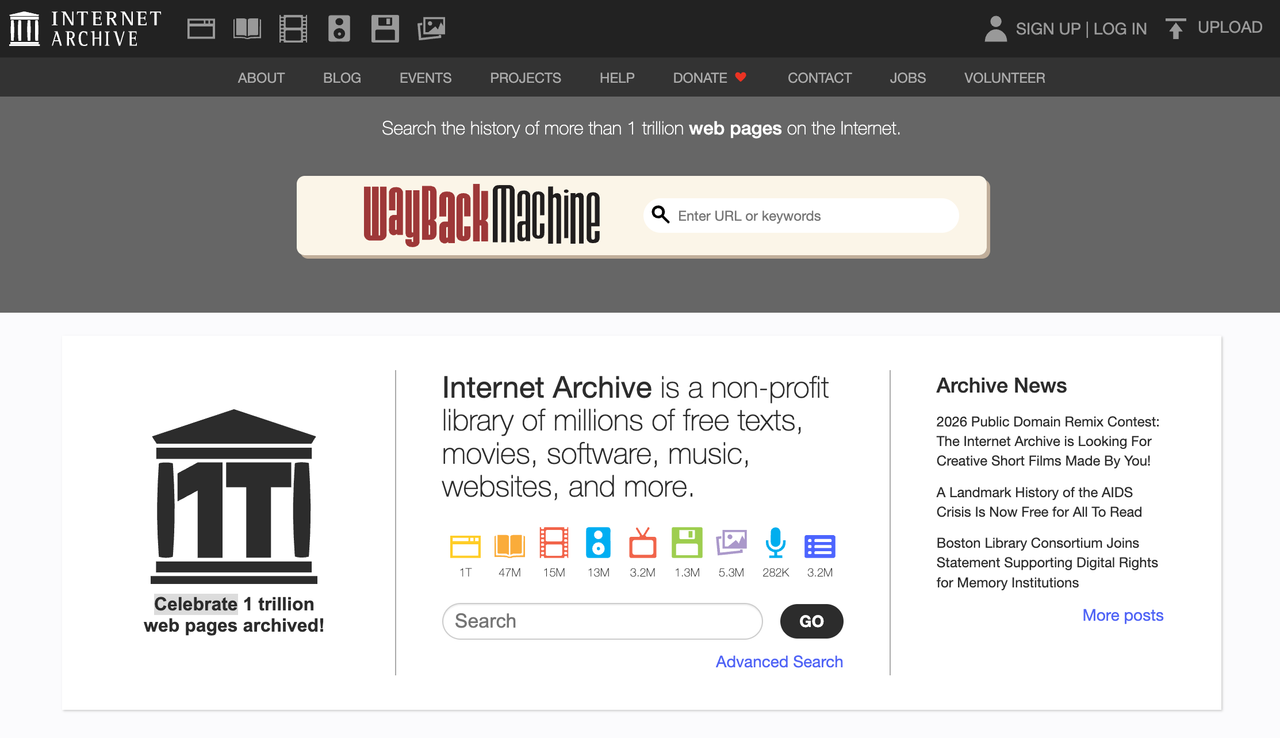
Currently, one copy of the Internet Archive is 175 petabytes of web history and counting.
Did you know that the Wayback Machine is currently archiving web pages at an incomprehensible rate of 150 TB of data each and every day? Oh, and that it's located in a church in San Francisco?
News outfit CNN caught up with the Internet Archive, which incorporates the Wayback Machine, recently. Located on Funston Avenue in San Francisco in a large neoclassical building that used to be a Christian Scientist church, the Wayback Machine now maintains 29 years of web history.
Back in 1996 at the inception of the archive, a whole year's worth of webpages added up to about 2 TB of storage. Now, a mere day soaks up 150 TB and a copy of the entire archive is 175 petabytes and counting upwards. In October, the Archive celebrated the successful storage of one trillion web pages.
While a set of servers have been "symbolically" placed in the former church building, the whole archive isn't actually stored in the Funston Avenue locale. Most of the archive’s servers are in a warehouse outside San Francisco, with copies distributed throughout the world.
Those backups aren't just prudent in the event of fire, flood or other physical catastrophe. CNN points out that the Trump administration has deleted large swathes of government websites.
“This change was huge. Whole sections of the web came down,” Internet Archive founder Brewster Kahle diplomatically explains. “(The administration) has a new point of view, and that’s why we have libraries to go and have the record.”
Of course, the internet archive isn't just about webpages. It also archives 49 million books, 13 million audio recordings (including 268,000 live concerts), 10 million videos (including 3 million Television News programs), 5 million images and 1 million software programs.
Keep up to date with the most important stories and the best deals, as picked by the PC Gamer team.
The organisation began digitising books in 2005. Currently, it scans 4,400 books per day in 20 locations around the world. Books published in or prior to 1929 are available for download, and hundreds of thousands of modern books can be borrowed through the organisation's Open Library site.
Source: PC Gamer